All eyez on Fed, with Friday’s quadruple witching adding to the potential for spiking volumes and volatility.
Oracle’s $300 billion OpenAI backlog propelled a massive rerating, but execution and funding risks remain; a deep dive on Oracle is coming later this month.
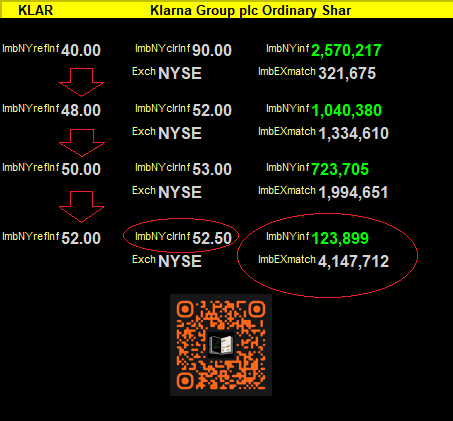
Klarna’s IPO fizzled after an initial pop, closing only 7% above issue price and 25% below its day-one high, highlighting a shaky IPO window.
Last week’s movers: KLAR, HOOD, APP, NBIS, ORCL and SNPS.
Earnings to watch this week: LEN and FDX.
2. Market Overview
Markets brushed off grim labor headlines and surged to fresh highs ahead of the Fed’s September meeting. The S&P 500 added 1.6% for the week and the Nasdaq rose 2% as Oracle’s blockbuster AI backlog and a slowdown in wholesale inflation helped fuel a midweek melt-up. Nasdaq notched its 22nd record close of the year, with technology, oil and gas, and financials leading sector gains while consumer services and telecom slipped. Gold broke $3,600 an ounce as the dollar weakened, underscoring the shift toward non-bond hedges just as Treasuries trade near a 4% floor. The coming week adds another layer of volatility with the Fed decision on Wednesday followed by September’s quadruple witching on Friday, when stock index futures, index options, stock options and single-stock futures all expire at once. That tends to spike volumes and can amplify intraday swings, especially with indexes at records and positioning heavily tilted toward large-cap tech.
Beneath the rally the labor data got darker. The Bureau of Labor Statistics revised payrolls down by 911,000 for the year through March and August unemployment hit 4.3%, its highest since 2021, with just 22,000 jobs added in August and June turning negative. That combination of sticky inflation and faltering jobs growth has flipped the narrative from inflation fighting to growth support. Futures now price a 100% chance of a cut this week, most likely 25 bps with small odds of 50 bps, and an 85% probability of three cuts this year. By late 2026 the market is betting on six quarter-point reductions versus the Fed’s median projection of three.
That policy shift matters because tariffs and a cooling labor market act as a tax on demand rather than the excess demand inflation the Fed was created to tame. Higher input costs and retaliation abroad squeeze corporate investment, hiring and wages. Trump’s tariff push is designed to rebalance production and extract concessions, but it is contractionary in the short term. Cutting rates now rather than waiting would avoid repeating the 1930s error of tightening into a slowdown and could lay the groundwork for an early cycle upturn instead of a late cycle stall.
Long treated as a cash-returning legacy database shop, Oracle has delivered a 437% total return since 2021 by executing a Microsoft-style cloud transformation. Cloud now makes up half of revenue, with Oracle Cloud Infrastructure growing 55% y/y. The company’s backlog of signed contracts jumped to $455 billion from $138 billion in three months, driven largely by a five-year $300 billion OpenAI deal. CEO Safra Catz projects $381 billion in server rental sales over the next five years, targeting $144 billion in cloud server revenue by fiscal 2030 versus $57 billion total revenue last year. That backlog news sent the stock up 36% this week and pushed its forward P/E from 19 at the end of fiscal 2024 to as high as 46. To justify that multiple Oracle would need Nvidia-style execution and OpenAI must fund its commitments. Oracle itself had $22 billion in operating cash flow against $27 billion in capex and added $27 billion in debt in the past year, bringing total debt to $112 billion. Both sides of the deal face hundred-billion-dollar questions.
For those who missed it, the September deep dive will be dedicated to Oracle and will be published toward the end of the month. It won’t be just my take – I’ve invited another sharp market mind who focuses on disruptors and next-generation stocks redefining the future to add their perspective, which should make it one of the most interesting Playbook pieces of the year.
Subscribe now to get it when it drops.
Klarna’s IPO was the mirror image of the week’s euphoria.
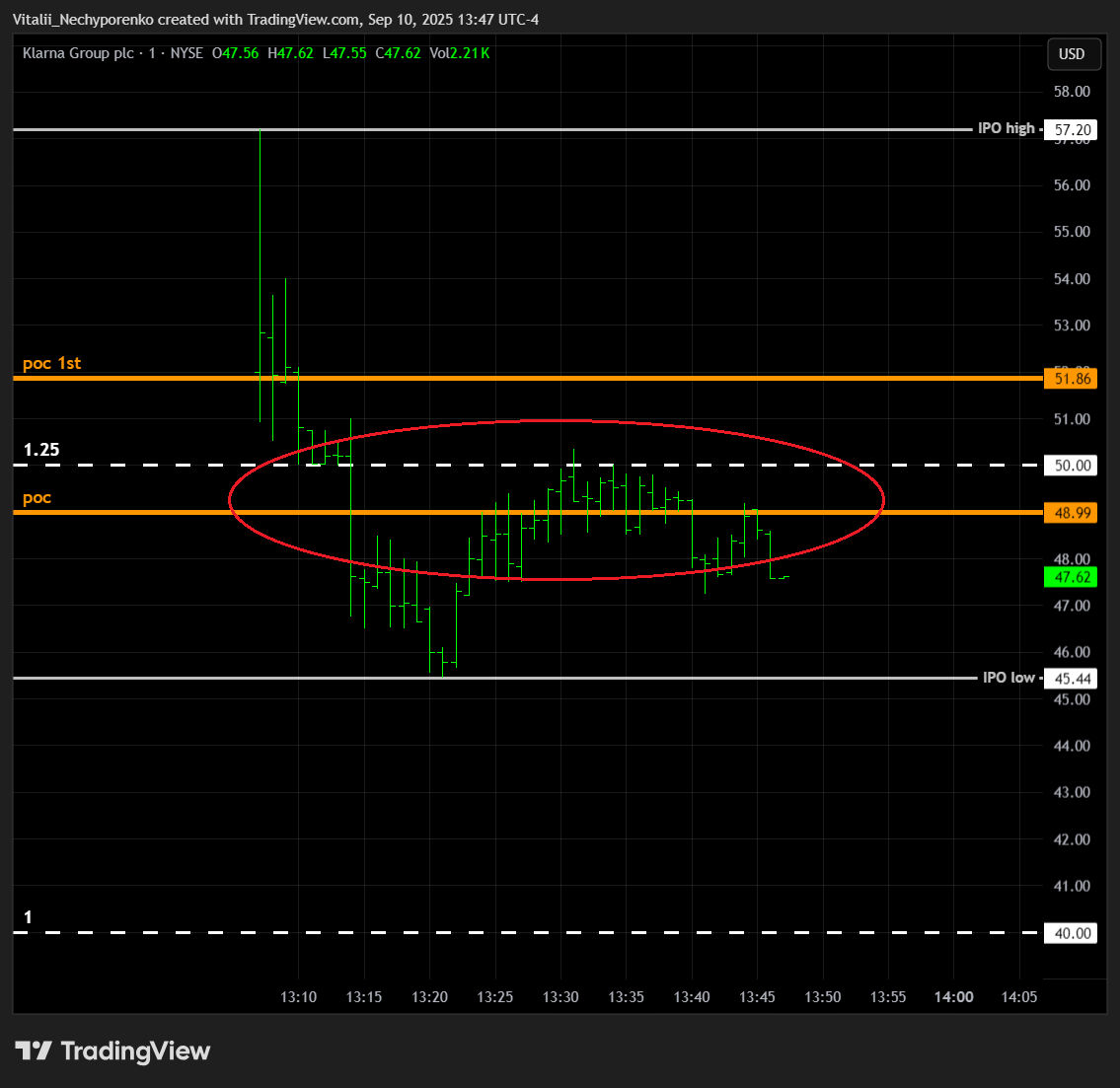
After shifting its reference price a few times it finally opened at 52, spiked briefly and then gave it all back.
The stock slipped under the fresh POC and 1.25 IPO extension at 50 and, after a couple of failed attempts to reclaim those levels, sellers controlled the tape into the close and over the next sessions. Oversubscribed and pitched as the next big thing in payments, it still finished the week only 7% above its IPO price and 25% below its first-day high, hardly a resounding success even by financial media standards. After a debut like that, traders are more likely to let it settle and base before chasing another buzzy newcomer, and with more listings lined up through year end the IPO window looks less like a launchpad than an exit ramp, with the term “window” itself feeling poorly suited for any of those needs. Even Barron’s underlined the point this week with an article named “Not Every IPO Can Be Hot. Sorry, StubHub.”
For now the tape reflects faith in policy relief and megacap resilience. Analysts still forecast 13% S&P 500 earnings growth next year and sector leaders like Oracle have delivered the kind of growth stories that feed early-cycle hopes. But with valuations stretched, jobs data deteriorating and Oracle’s backlog hinging on a single massive customer, the coming Fed decision will set the tone for whether this marks the start of a new leg higher or just another rally on thin ice.
Since The Compound and Friends is at Future Proof right now, and the latest episode is geared more toward financial advisors and planners than to traders and investors I’m highlighting a Prof G Markets episode again. This one featured China economist Alice Han and a segment on the BLS jobs revision. For a while China was considered “uninvestable” by many investors because of weak macro conditions, real estate stress, policy crackdowns and foreign capital outflows. India became the favorite in emerging markets with stronger growth, investor confidence and more stable policy signals. Now the tables seem to be turning again.
Beijing isn’t playing timid anymore. It staged a massive military parade with a geriatric russian war criminal and a chubby North Korean tyrant waddling around like they're auditioning for a failed dictators' circus, and a crowded Shanghai Cooperation Organization summit as a signal of deterrence toward the US including Taiwan and proof that China has partners in trade, security and influence outside the Western orbit. Exports to the US are plunging while shipments to Africa and Europe surge. BYD is accelerating in Europe. At home Beijing is pushing a quiet bull market as households move deposits into equities, Hong Kong and mainland benchmarks rise sharply year to date and foreign investors circle back in seeing China both as an AI lever and as a hedge to US policy risk.
China’s AI push is now more than rhetoric. The AI Plus plan aims for around 70 percent adoption of AI powered devices and agents by 2027 and 90 percent by 2030. DeepSeek appears to be a tipping point, shifting sentiment from “can China catch up” to “AI will power practically everything” including government workflows. In that backdrop Alibaba emerges as a pillar with large scale in cloud, consumer platforms, data and commerce reach. If China is becoming investable again Alibaba is one of the names you would expect to lead that swell.
Meanwhile the currency picture is telling. The yuan is holding up helped by dollar weakness and a PBOC that is resisting devaluation likely to avoid sparking new trade friction. There is even talk of a Plaza style understanding later this year to keep the CNY elevated.
On the US side the BLS calculated a benchmark revision that cut March 2024 to March 2025 job gains by about 911,000, the largest revision ever. It was framed not as politics or lying but as capacity issues with response rates down around 20 percent, budget cuts and staff shrinkage even as policy and markets lean heavily on these figures.
Watch the full Prof G Markets episode here:
3. Earnings & Interesting Movers Recap
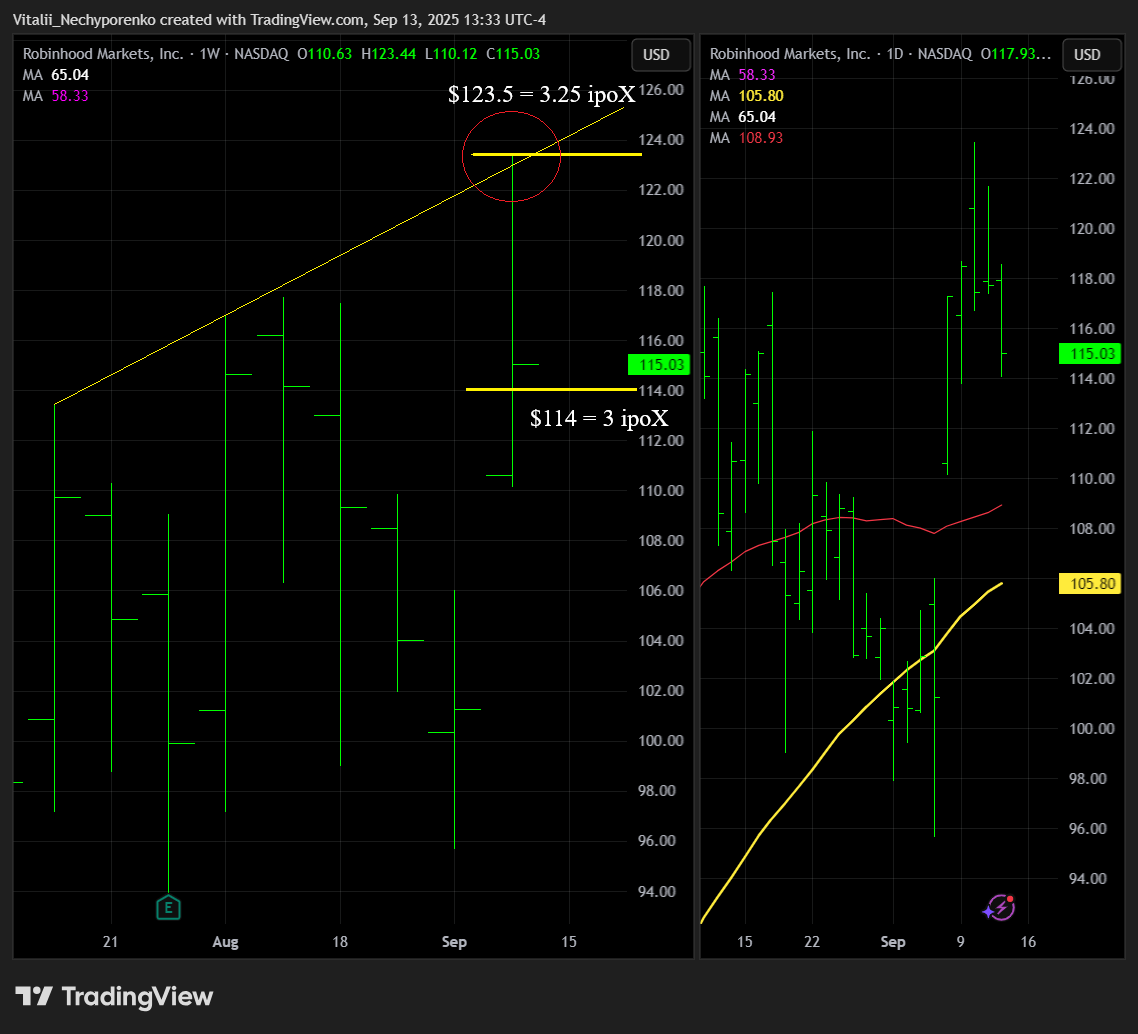
HOOD +13.61% 1W
Robinhood’s inclusion in the S&P 500 marks a shift in how the market sees the company. Bernstein (PT $160) argues it is no longer just a platform for speculative retail traders but an emerging multi-asset financial “superapp” for the next generation. Trading remains the entry point, but the firm is building an aspirational low-cost banking and wealth suite for its 3.5 million Gold subscribers, with superior deposit rates, a new credit card already at 300K issued and a long waitlist, and private-banking style perks. August operating data reinforced that pivot: funded customers held steady at 26.7 million with a year-over-year gain of 2.4 million despite a one-time escheatment of low-balance accounts, total platform assets rose to $304 billion, net deposits hit $4.8 billion in the month and margin balances climbed to $12.5 billion. Equity and crypto volumes remain well above year-ago levels even with some month-to-month softness, showing a broadening base of activity beyond trading spikes. With only 2.7% of the broking and advisory revenue pool, its execution and product velocity are seen as best-in-class.
The stock ripped through the 114 (3 ipoX) key resistance area and printed a new all-time high just pennies below the 3.25 ipoX level at 123.50 with a brief fakeout of the weekly TRL, but the zone was rejected and momentum faded toward the end of the week amid the August operating data. With a large closing imbalance expected on the S&P 500 addition date Friday, the tape is likely to stay volatile and it will be worth watching for any opportunity that emerges.
APP +18.72% 1W
AppLovin’s addition to the S&P 500 gives it a long-awaited visibility boost, forcing index funds to buy shares and putting the ad-tech player in front of more institutional investors. The company has shown strong growth with its gaming advertising and upgraded tech stack, while the MAX Marketplace remains a core engine enabling steady expansion. Its new Axon Ads Manager, a self-service platform aimed at broader advertisers, reduces friction with credit card billing, campaign control and automatic ad generation, setting the stage to scale beyond gaming. With AI-driven ad tools layered onto a booming marketplace, AppLovin is executing well on both current opportunities and its longer-term vision.
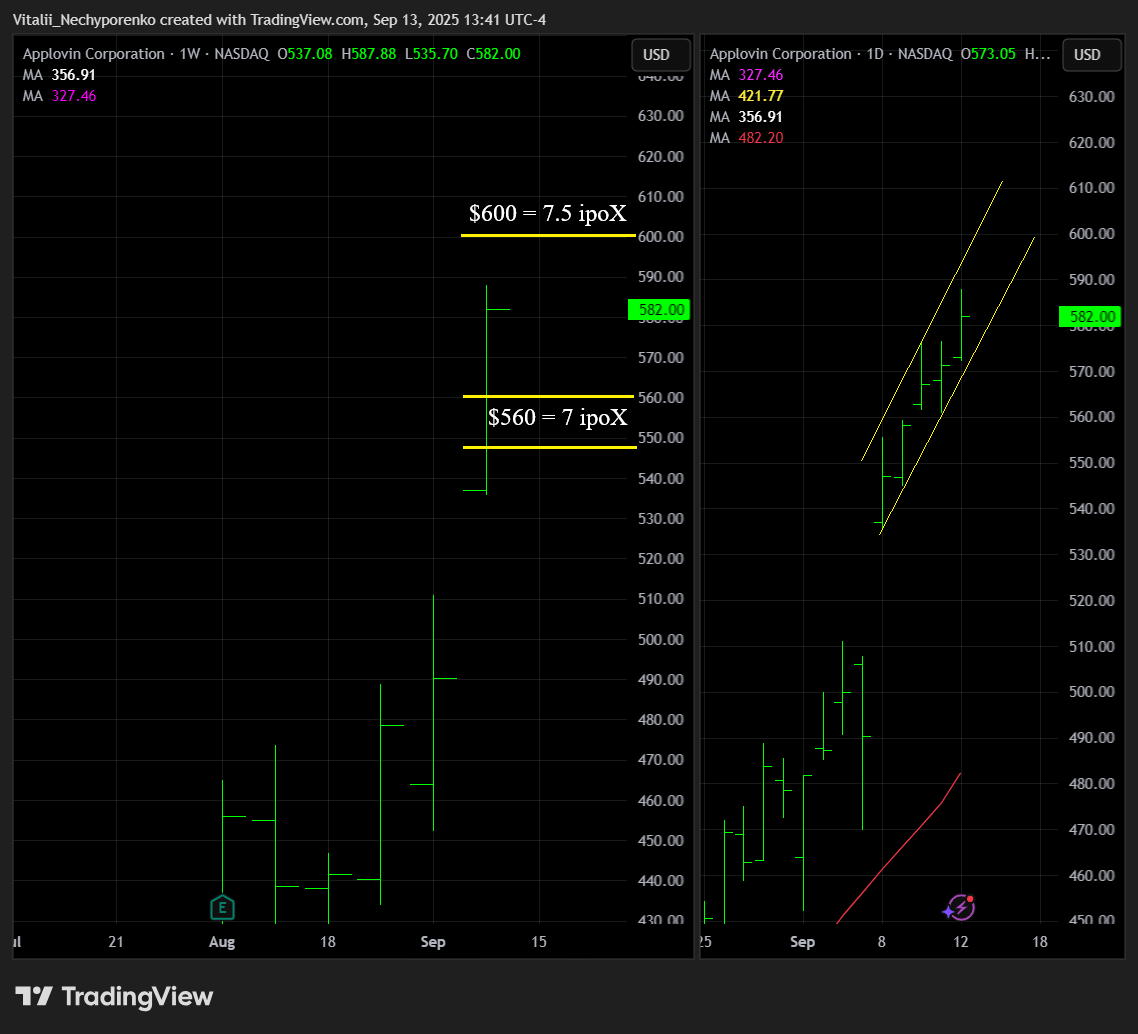
The stock initially reacted to the 548.5 key resistance but momentum held and it flipped the area, clearing the next level at 560 (7 ipoX) and ripping higher. The 600 zone could be especially reactive as the 7.5 ipoX converges with the big weekly TRL, and with the main action set for Friday it will also be worth watching the final 10 minutes of trading closely.
NBIS +38.09% 1W
Nebius Group landed a transformational AI infrastructure contract with Microsoft worth $17.4 billion through 2031, with potential to reach $19.4 billion if additional capacity is purchased. The deal gives the Amsterdam-based company a step change in visibility and predictable long-term revenue, validating its GPU-heavy data center buildout in Vineland, NJ and cementing it as a serious contender in the AI cloud race. Nebius builds full-stack AI infrastructure, with side ventures in autonomous vehicles and tech training, but AI remains the core business. Management says this is the “first of these contracts,” hinting at more large-scale partnerships. Capex will rise sharply but Nebius plans to fund it through deal-related cash flow and debt backed by the contract. Concurrent equity and convertible-note offerings are aimed at financing new greenfield sites and expanding its customer base from AI-native startups to larger enterprises. Execution risk remains as this is a massive scale-up for a relatively small player but the market opportunity is clear.
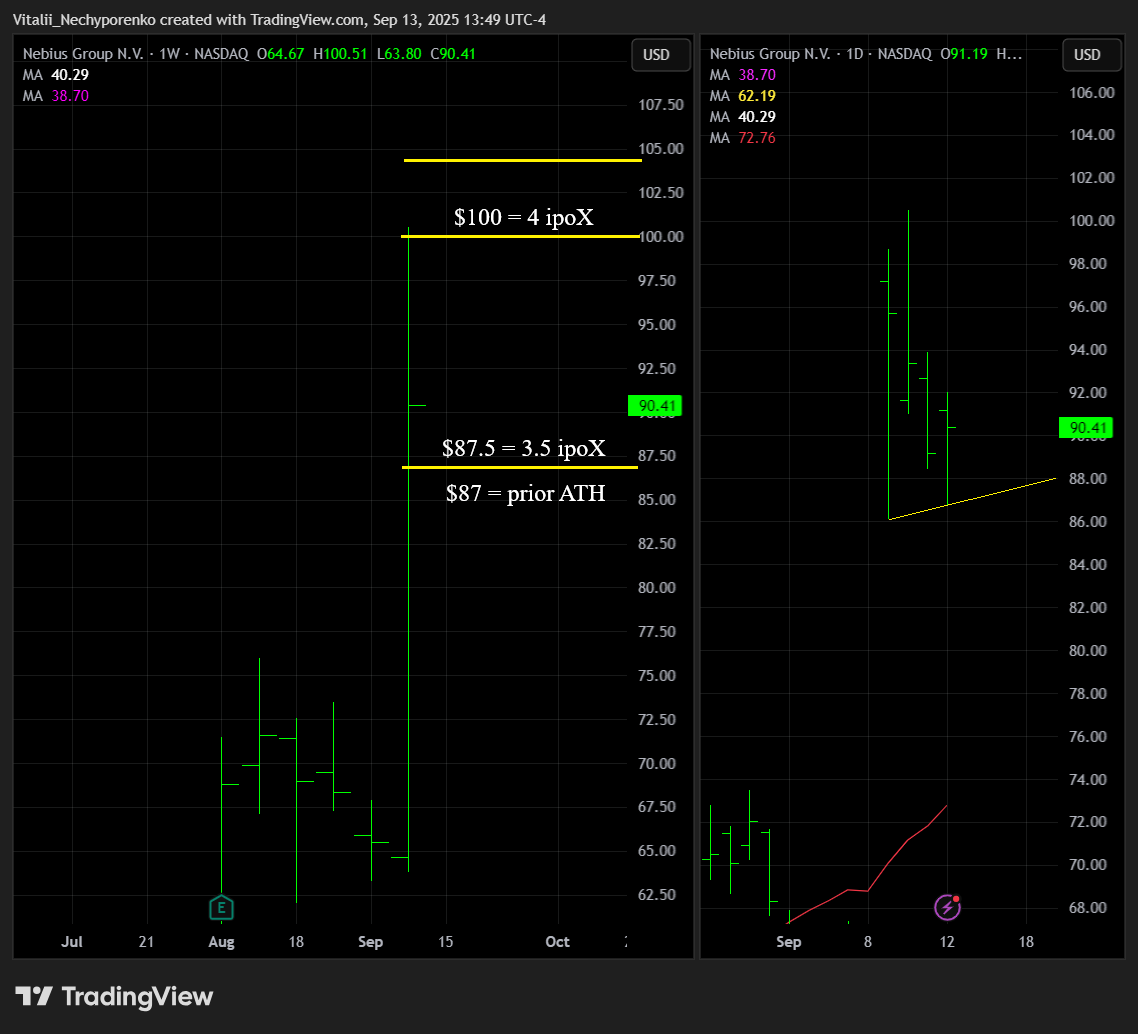
The key resistance at 104 (big MM target and weekly TRL) was frontrun by profit takers as sellers stepped in at 100 (4 ipoX), and the supply there was confirmed the next day when the stock was clearly rejected again. The prior ATH at 87, coupled with the 3.5 ipoX at 87.5, remains the level where buyers are willing to step in, showing reactive upside on both the gap day and Friday. However, the stock closed below the 93 key resistance area where a couple of big weekly TRLs converge. It still looks constructive as long as 87 holds, but given the heavy retail exposure deeper pullbacks and choppiness would not be surprising.
ORCL +25.51% 1W
Fundamentals of Oracle’s blockbuster quarter and $300 billion OpenAI backlog were already covered in the Market Overview section and the upcoming deep dive will take the rest apart in detail.
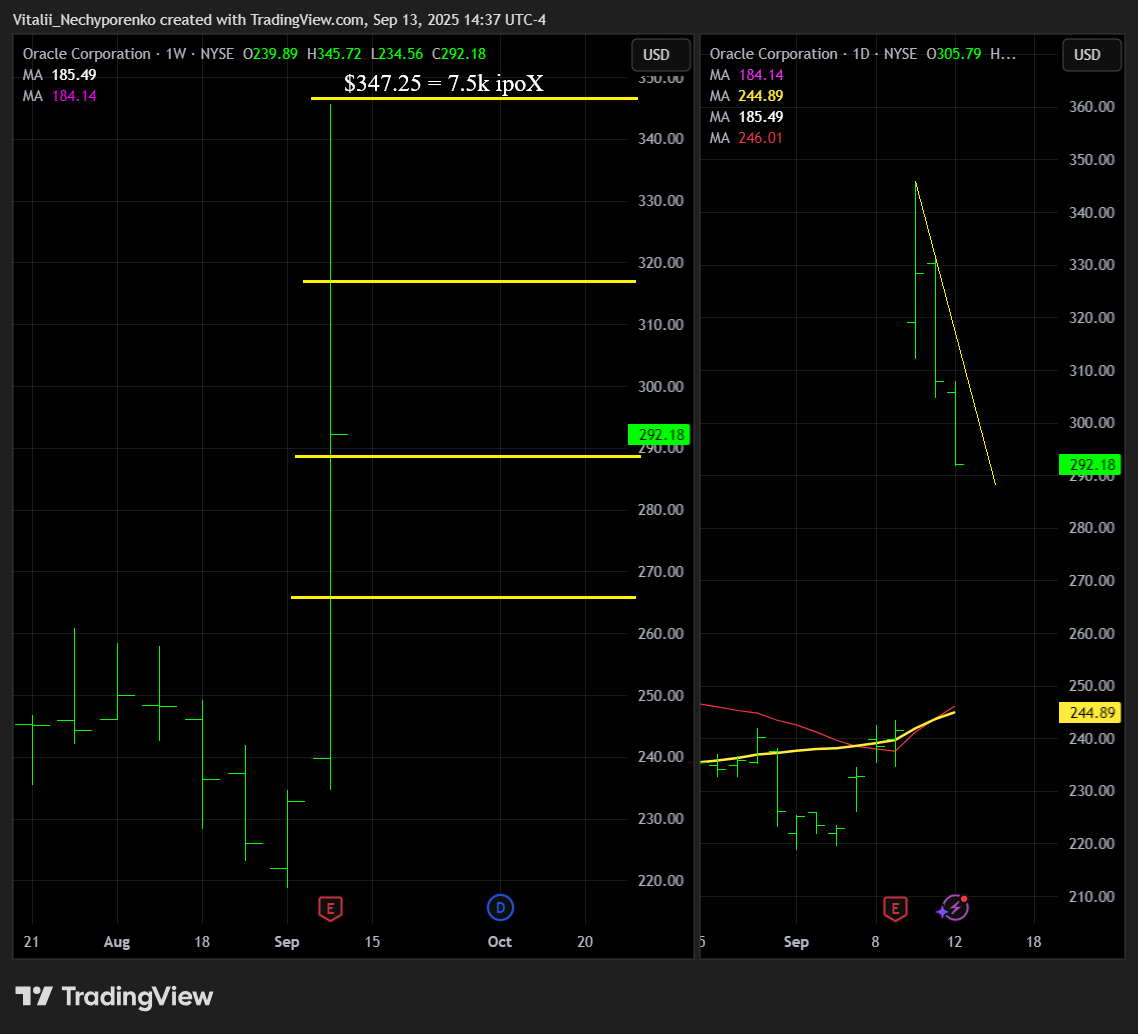
The stock cleanly flipped the 266 key resistance area mentioned pre-EPS and never looked back. It topped out near the 7.5k ipoX level after which sellers took control, closing the week couple points above the prior resistance area at 289, but well off the highs.
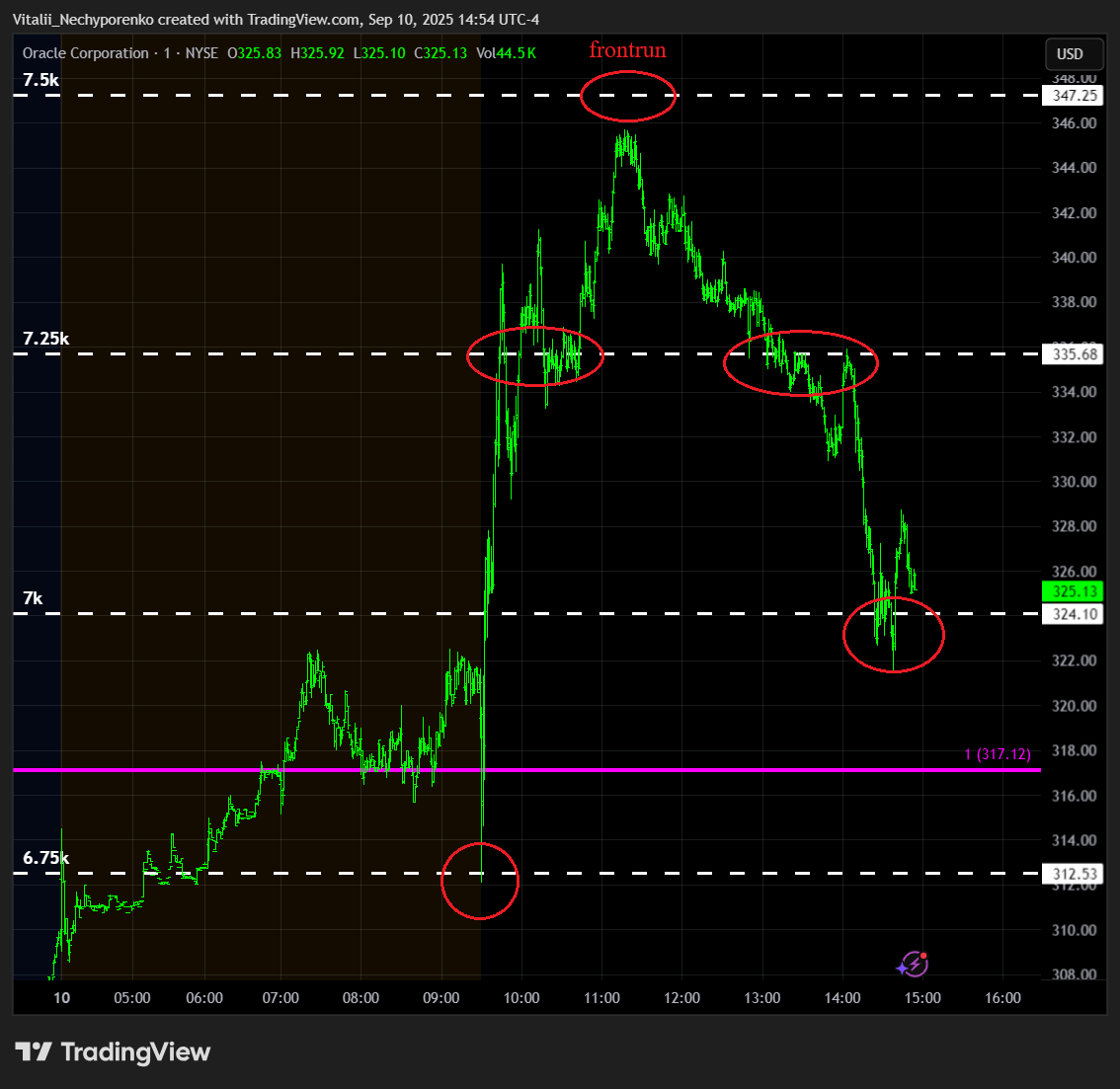
Let’s take a closer look at the intraday chart on the first day:
Big MM target at 317 acted as a magnet as the buy imbalance on the first day wasn’t enough amid heavy NYSE OPG sell limits to open higher and it presented a clear shorting opportunity before the open. The price action was a textbook display which is not surprising given the dollar turnover in the name. Just look how it respected the big IPO extension levels.
I’ll also shed some light on opening auction mechanics in an upcoming piece that will be part of the Market Mechanics Playbook scheduled to run closer to the autumn earnings season. Stay tuned!
SNPS -28.87% 1W
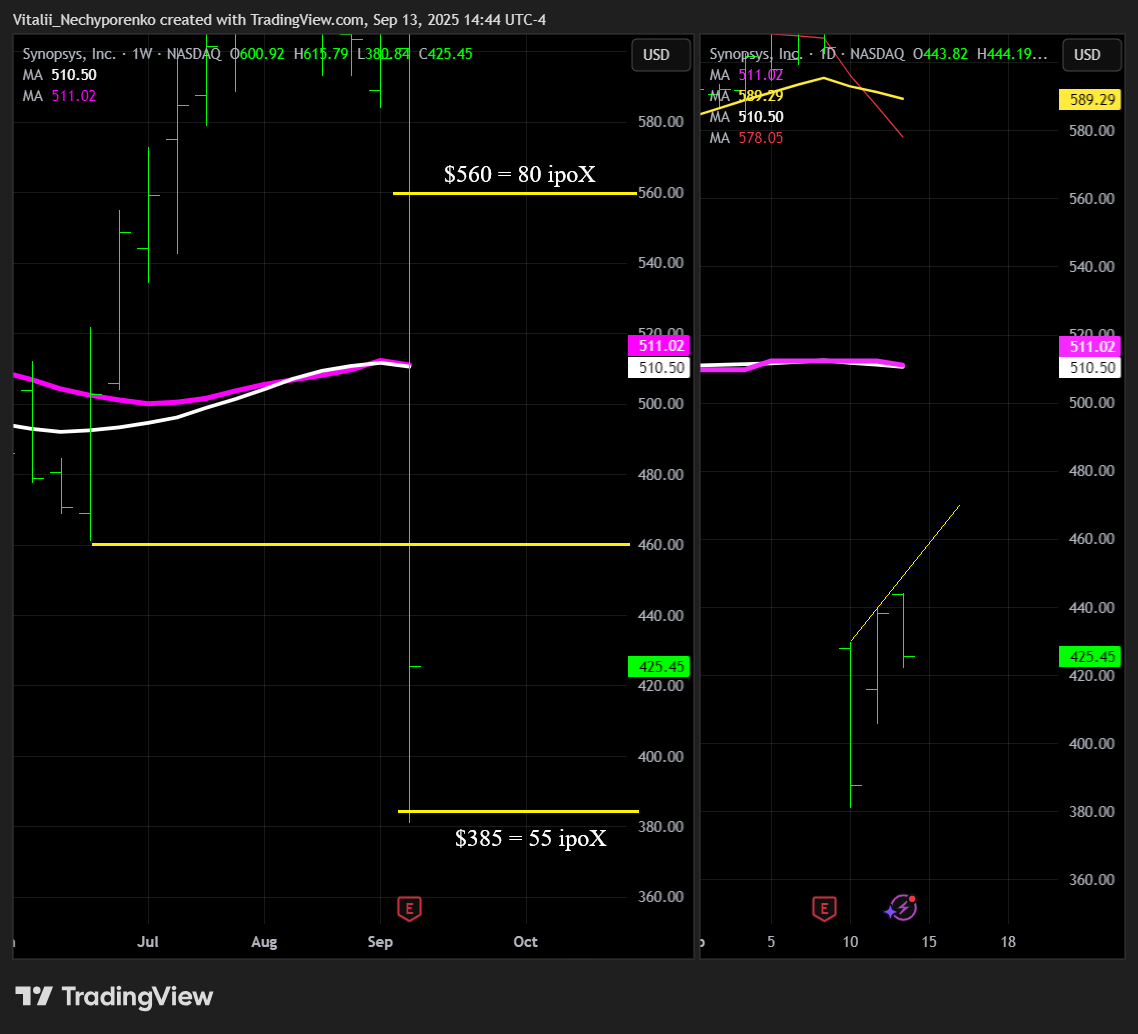
Synopsys delivered mixed Q3 results with revenue of $1.74 billion and EPS of $3.39, but the headline was an 8% year-over-year drop in Design IP sales to $428 million. Management cited U.S. export restrictions in China, problems at a major foundry customer and internal missteps, all of which are expected to weigh on the segment beyond just one quarter. Design Automation revenue rose 23% to $1.31 billion, supported by resilient EDA demand and Ansys’ contribution following the recent acquisition. The company reinstated FY25 guidance, issued a Q4 outlook and announced a 10% workforce reduction, framing FY25 as a transitional and muted year for IP before recovery in FY26. AI-driven infrastructure and R&D spend remain tailwinds for design automation, but uncertainty around China and its largest IP customers is likely to keep investors cautious in the near term.
The stock broke below the 560 key support area in aftermarket trading and sellers seized full control. The 459 level, a recent pivot low combined with the 2023 POC and the weekly UTL, was also flipped in the premarket amid mounting selling pressure. Buyers stepped in near 385, where the 55 ipoX aligns with two converging big weekly trendlines, after slightly undercutting the area. The 459 level should be monitored closely as it could now act as resistance and the recent pullback may set up another leg lower.
4. Key Index Charts
It was a strong week for the indexes though small caps lagged, and even Bitcoin managed to reclaim 112k, at least for now. Bonds kept climbing ahead of what is shaping up to be the most anticipated FOMC meeting of the year. Let’s go to the charts: